All posts by Doug Murdoch

Backpack and luggage fanatic, obsessive runner, and world traveller. I take some photos now and then. In the afternoon I enjoy a double caffè macchiato with a small cookie.

Advice from Empire Runners: Staying Motivated Through Injuries

Empire Members answer the question, “How do you stay motivated during times of injury, and how do you motivate yourself to start up regular training again?”

March2016Advice001Catherine DuBay:  How to stay motivated during an injury is a good question and can only be answered by asking yourself, “How do I stay motivated when I’m NOT injured?” Motivation is a very interesting concept and every runner or wannabe runner needs to recognize what motivates them. Is it to lose weight? Look good for my class reunion? Make my ex jealous? Beat my training partner at Kenwood? PR? Etc.

Then you have to decide what type of running you like to do so you can give yourself a fighting chance to be successful. If you like nature, then try trails. If you like to run with others, then join a club or running group. If competition or traveling is your thing, then sign up for a race near or far. The key is to set yourself up for success by finding something that makes running tolerable, because, let’s face it—it is not easy day after day after day.

Once these two questions are answered (why you want to run and what type of running gets you excited), then you can apply these motivators to anything you do. Even for injured runners. What is your motivator for exercising while injured? What kind of exercise (besides running) can I tolerate? Indoor cycling classes are the best for injured competitive runners. Indoor cycling produces the closest thing I have found to that post-run feeling.

March2016Advice002Bill Cusworth: This will probably come as a surprise, but I’ve never suffered an injury that required an extended layoff from running. I’ve had injuries, of course, but none that lasted more than 3-5 days or so, and the short break from running was welcome and likely beneficial. I’ve also had nagging issues such as bruised feet that lasted for a month or more, but I was always able to run through them. My longest periods of not running have been due to sickness or weather. When I start back up, I do low mileage and build back up to where I was. If you try to get back to previous mileage levels too soon, soreness may result, which negatively impacts motivation. If I ever did have an extended layoff, I would try to concentrate on upper body and core exercises as I generally don’t do enough of them and I would try to use the opportunity to develop new good habits.

March2016Advice003Sarah Hallas: During my 2+ decades of experience with countless injuries, I think the biggest motivator carrying me through my time-off stints has been just looking forward to my next event. I try to find a race that is far enough out that I don’t start stressing over not being able to run. I also try to remember that being injured is usually the body’s way of telling us to TONE IT DOWN, which is hard for most runners since we are mostly wired the same. Usually during this time, I swim lots of laps, do lots of core, get lots of massage/rehab work done, and enjoy the mornings of sleeping in.

March2016Advice004Michael Wortman:  When confronted with an injury, the best advice for staying motivated that I can give is to find what motivated you to begin with. If there was a race that you were training for, a goal you were trying to achieve, figure out what it was that was driving you in the first place. Even if you’re injured, the endgame is still there—you just need to find a new route to get there. This means if you can’t run, find some form of comparable cross training to fill the training session. Using your original motivation can help you through drudging pool workouts or extended bike sessions. If done right, cross training can keep you fit and get you healthy quicker, so when you return to running, you haven’t lost much training in effect.
March2016Advice005Tori Meredith: I totally agree with Mike Wortman. I have had my share of injuries in the last couple of years. My motivation is to be able to feel good about myself, sleep well and be alert.  I find that when I don’t exercise I am very sluggish and I don’t accomplish anything. Since I don’t drink coffee my get-up and go has always been to exercise. Depending upon my injury,  if I could not run then I  would do more swimming, run in the pool or ride my bike but I find that nothing takes the place of running.  Running keeps my weight in check, my system working,  and I feel energized.

March2016Advice006Alex Wolf-Root:

Spite.

Now hear me out. There are more rational reasons to keep at the cross-training (it’ll be easier to transition back to running, you’ll rehab faster, you’ll be mentally more sane, etc.), but we all know that. So if you need motivational advice beyond that advice, what should you do? Say “#@##, injury!”

Look, you’re pissed that you’re hurt, and rightfully so (even if it was your own stubbornness that got you hurt…). So use that anger. Channel that passion into cross-training. That cross-training is how you get back at the injury, how you get back at the shitty hand that life dealt you. In spite of whatever happens, you’re going to come out stronger and better than ever.

Spite is not a way to live your life generally, but if things are in a dark place, and rational reasons to work hard are failing, channel that anger, say “#@##” to your injury, and go get in the darn pool!

March2016Advice007Mike Fanelli:

Now in my 47th consecutive year of training and racing, I look back on said time spent in sport as a series of careers between injuries. Thankfully, some of those careers lasted longer than others. It is an inevitable part of red line running “on the edge” that, in order to achieve one’s maximum potential, there shall be periods of “brokenness.” How long these periods last is a function of how quickly one is willing to accept the bitter pill of down time, and how aggressively one pursues healing solutions. One thing is for sure—the body is an amazingly adaptive machine. Our recuperative powers are nothing short of astounding.

What to do when injured is a competitive runner’s ongoing dilemma. My counsel to athletes that I have coached over the years (including myself) is to absolutely bombard the area with care. In addition to all the normal modalities, extra sleep, hyper-hydration, anti-inflammatory resources, nutritional supplementation, and a wide array of ancillary bodywork protocols can help expedite recovery.

If possible, non-weight-bearing activities like pool running, Elliptigo, and workouts on stationery gym equipment can assist in maintenance. Push-ups (oft referred to as the most perfect form of calisthenics) and an ongoing focus on core work are a must. Using the fallow period to pinpoint weaknesses not normally addressed while fit, and then improving upon them, can produce a long term benefit when once again healthy.

Rather than removing oneself from the sport, staying engaged by volunteering and spectating at races in which you’d normally compete lends both perspective and appreciation. Gratitude has remarkable healing powers.

I also recommend deep reading and learning. There are so many great written works that inspire and foster the “dare to dream” instinct. The list is endless.

Whatever you do, keep a detailed daily log, chart progress with appropriate metrics, and most importantly, embrace the notion that said shut-down is merely temporary.

Here’s to your health.

March2016Advice008Lori Barekman:  As a physical therapist, I have frequent reminders of how lucky we are to enjoy running when things are going smoothly. Running is freeing; it takes us to places where we can be awestruck by the things we encounter. And we can learn so many things about the people around us as we share some time together on our run. However, running can be demanding on our bodies, and it takes work to make sure that our bodies are ready for these demands. We are in a high-risk sport if you look at the statistics for injuries.

What keeps me moving when I am recovering from some type of injury is the opportunity to work on other aspects of fitness. I enjoy having my daughter direct our morning workout of jumping jacks, planks, and pushups, and it sets a good tone for the day. Having time to walk my non-running dog (she refuses to do more than trot) with other family members gives us the chance to talk about what’s going on in our lives. I also like going to meet a non-running friend at the gym for the same reason. At other times, going to a yoga class “alone” is just the ticket for some relatively quiet time. Since rest is also an important aspect of any training routine, I like having down time to relax or get chores accomplished. My New Year’s resolution every year is “lower your standards,” which sounds silly, but honestly sometimes I have to remind myself to just do what I can and let the rest go. I have learned that I will never be in the perfect shape for the events that seem to attract me…but “good enough” allows me to stay motivated and keeps me from driving myself (and those around me) crazy when I wish I could do more to get in ideal condition. We have to listen to our bodies, and pushing through an injury is not the answer for the best long-term health. I am in this literally and figuratively for the long run.

Steve Agar:  I usually just rely on cigars and whiskey to get me through.

March2016Advice009

Brad Zanetti: In dealing with an injury that stops one from training and racing it is imperative that recovery is undertaken with the same passion that one has for training and racing.  In fact, it could be more appropriate to bring more passion, education, and new understanding to recovery. Then with this renewed passion and new found stregnth inject yourself back into the sport and lifestyle you love.

March2016Advice010

Val Sell: We can all relate. Haha…

March2016Advice011

Tell it to me straight, Doc. Can I still run this weekend?

Got Blisters? An interview with Rebecca Rushton, by Doug Murdoch

Feb16Murdoch03(This is an interview with podiatrist Rebecca Rushton, author of  The Blister Prone Athlete’s Guide To Preventing Foot Blisters. You can also visit her website, www.blisterprevention.com.au)


Hi Rebecca! I must admit that being a blister sufferer, I had scoured the internet looking for information to no avail. When I came upon your book and website, I said to myself FINALLY!! Why do you think it has taken so long for something so important to be written about in a comprehensive way?

I’m at a loss to explain it, Doug. I’m as surprised as you. Especially considering blisters are such a common injury in sport and everyday life. But it’s been a pleasure to plug that gap. Thank you for your kind words – it’s very rewarding to make a difference in such a specific way.

You know sometimes you think about particular types of doctors    (I won’t mention them here) and you wonder how in the world they became experts in a particular area? So…..blisters……..what is it intrinsically about blisters that caught your interest enough to become an expert on them?

Well, as a podiatrist, if I was going to be an expert on anything, it was always going to be something about feet. The reason that thing is blisters is because I happen to be blister prone. I get foot blisters very easily – when I go for a walk, run, play hockey, new shoes. It’s so annoying. But I’ll tell you what hurt most was the moment I realised I couldn’t fix my own foot problem when it was my job to fix foot problems. That was the impetus for delving deeper into this injury.

It seems to me that many runners and athletes think that certain types of blisters are no big deal, so they really don’t take the time to treat them correctly or prevent them. In your experience what are the most common blisters, and if runners put some effort into it, are they preventable?

Blisters anywhere on the feet are absolutely preventable. The reason people don’t put much effort into blister prevention is that too many of the things they’ve been told to do, don’t work. And so blisters are deemed to be inevitable. Have you noticed that athletes tend to glorify blisters like they’re a sign of how far they’ve run or how hard they’ve worked? It’s a sorry state of affairs, but they don’t see any way around it. So it’s very satisfying to help turn that reality around. I want for athletes to be able to understand blisters and their options a bit better so they can troubleshoot issues themselves. That’s why I’ve spent such a long time researching the literature to help explain what’s going on, in a way that’s easy to understand.

It seems so obvious after I read it in your book, but it never occurred to me that the foot bones move around under the skin which can cause stretching under the skin – you call it shear. It’s probably just something people don’t normally think about. Does the amount of movement differential between the skin and bones vary significantly among individuals?

It does Doug. That means we can have an impact towards blister prevention with certain biomechanical interventions that reduce bone movement – things like orthotics, stretches and changes in running technique. Another variation we see between individuals is that of the skin’s resilience to that movement differential between skin and bone (shear). Even with the same running speed, distance travelled, terrain, shoes, biomechanics, training regime and everything else being equal, some athletes are going to blister sooner than others, just because of the intrinsic shear strength of their skin.

Feb16Murdoch05

Friction seems to be a very important concept to understand – can you briefly telling about this in relation to blisters?

Friction has a double meaning. One is rubbing, the other is resisting rubbing. This one factor alone has led to a confused mainstream blister prevention paradigm. Everyone’s out there trying to stop the rubbing on their skin, but this shouldn’t be our aim. Our aim should be to lower the resistance to rubbing. This is what reducing friction means.

Put simply, friction is the level of grip between the surfaces of the shoe, sock and skin. High friction levels cause them to grip together, and this makes that movement differential between skin and bone to be bigger, leading to more blisters, bigger blisters and blisters sooner. Our aim should be to reduce the grip – make it slippery. If you can have an impact on friction levels, you will go a long way to stopping blisters.

One of the things I’ve noticed is that different types of running can cause different types of blisters. For example if I’m running significantly faster or sprinting, I know that my foot strike and body mechanics are different. Or if I run trails I may get certain blisters I don’t get otherwise. I suppose it’s less important but I didn’t see anything in your book at particular types of running causing blisters.

You’re right Doug. When you run in a straight line, your foot plants and your foot bones continue to skid forward until they come to a stop. That’s the movement differential we call shear. And the opposite happens in the propulsive phase. So the shear happens in a forwards/backwards direction. Compare that to trail running. The more challenging the trail becomes, the more your bones slide from side to side. And the more you might load other areas of your foot in different ways. So you’re quite right – different terrains, different blisters.

Your book covers the treatment of heel blisters, arch, under the ball of your foot, and all types of toe blisters. Which blisters are the most problematic? Can blisters actually be chronic?

Feb16Murdoch02Toe blisters seem to be the most common. I took a poll on my website and 36% of 1,136 respondents had toe blisters. The next most common was blisters under the ball of the foot (28%) and I think these are the most problematic for runners. The main reason is runners don’t want to take time off running to let blisters heal. I don’t know if you’ve noticed but it’s very hard to run when you’re trying to keep the weight off your forefoot.

One of the most common questions I’m asked is “how long is my blister going to last”. The fact is, your blister won’t resolve in a hurry if you haven’t reduced the shear load on that part of your foot. To get your blisters to heal as quickly as possible, you have to reduce friction levels (I’m not talking about rubbing, I’m talking about how your shoe, sock and skin all grip together – you have to make it slippery at one of these interfaces). That’s the best way to reduce shear. Plus I’d try to reduce pressure if it was possible. There are lots of ways to achieve these things, but it depends on where on your foot the blister is. Different blister locations require different strategies for best results. That’s why I focus on the ten most common blisters by their anatomical blister locations in my book, and describe the most useful prevention strategies for each.

It seems to me that most peoples understanding of blisters is pretty pathetic……whenever the subject comes up, the standard response is “are you using Moleskin?” which really irritates me since I know it does not really work well, at least for me. That’s why I found your discussion of taping, felt donut pads, and ENGO patches quite informative. Tell us about the ENGO patches since I don’t believe many people have heard of them.

I agree Doug. I feel the same way about taping. I can tape my heels til the cows come home but I’ll still blister under the tape. But you can’t deny the fact that less blister prone runners only need a little bit of something to keep them blister-free. I used to wish I was one of those people. But thankfully I’m not, because it has made me delve deeper and find real solutions for even the most blister prone athletes. ENGO Patches are the things that keep me blister-free. I actually found these patches and fixed my blister issues before I started looking into the science of blisters. When I found they worked so well, I had to figure out why, because they didn’t fit into the paradigm as I understood it at the time. That’s how I figured out that paradigm (ie: stop the rubbing) was flawed.

ENGO Patches are made by Tamarack, Minnesota, USA. They’re self-adhesive, low friction patches you apply to your shoe, insole or orthotic, rather than your skin, so they’re quite different to other strategies. They last month on month for around 300 miles and they’re very thin. They reduce friction in a targeted way, which is the best way to manage friction. I highly recommend them for anyone blister prone and any athlete bothered with blisters because of their sport.

Feb16Murdoch04

Tell us about your website, and is it possible for runners that have serious problems to contact you for treatment via email, skype, or ?

My website is www.blisterprevention.com.au and it’s a treasure-trove of practical advice on specific blister prevention strategies, on the different blisters based on their anatomical location, on sport-specific blister issues and on blister treatment principles. I have a slant towards runners, particularly multiday ultramarathon runners, and blister prone people – so I focus on the advanced techniques needed to make a real difference. If your readers are having trouble, I urge them to have a good look at the topics covered – I’m sure they’ll find something new they can try. Unfortunately, I’m quite busy with my own podiatry practice that I don’t have a lot of time to speak to people one-on-one. But I do have an online consultation service if anyone wants me to take a look at their blisters and walk them through their best options. Other than that, I go to one 6-day ultramarathon a year to provide foot care, which I really enjoy doing. This year I’ll be at the Big Red Run, Australia’s annual 6-day ultramarathon in the Simpson Desert. It’s going to be fun.

Where can runners buy your books?
My book is available from Amazon at http://www.amazon.com/dp/B016R6YAIS on Kindle and as a paperback.

Feb16Murdoch01


Pro Photographer Chris Chung: Member Interview

Question: As a professional photographer for the Press Democrat shooting sports, do you “see things” or observe things while taking photographs that the normal spectators may not appreciate?

San Francisco Giants right fielder Hunter Pence grabs a fly ball by Washington Nationals batter Jayson Werth in the sixth inning, during Game 4 of the National League Division Series in San Francisco on Tuesday, October 7, 2014. (Christopher Chung/ The Press Democrat)
San Francisco Giants right fielder Hunter Pence grabs a fly ball by Washington Nationals batter Jayson Werth in the sixth inning, during Game 4 of the National League Division Series in San Francisco on Tuesday, October 7, 2014.
(Christopher Chung/ The Press Democrat)

Answer: I don’t think it’s so much that I see or observe things that normal spectators may not appreciate. Everyone interprets the world differently based on the whole of their life experience. The difference in seeing within any group of professional shooters can vary a great deal. But I do think that shooters as a whole are more inclined to look for different angles and moments, and are motivated to challenge themselves visually a little more. You might be looking for interesting light, graphic elements, or good interaction/reaction, in addition to peak action.

What’s your favorite sports photo of 2015 and why?

If I had to pick a favorite image of the year, I suppose this is it. It's of Golden State Warriors guards Stephen Curry and Klay Thompson celebrating their win over the Houston Rockets during Game 2 of the NBA Playoffs Western Conference Finals at Oracle Arena, in Oakland on Thursday, May 21, 2015. While shooting sports, I have to keep reminding myself to keep shooting after the action ends. A lot of photographers are much better than I am at doing that. I shoot a lot of sports, but I don't consider myself a sports shooter. I think I got it right here. It shows the jubilation of a one-point win, and the cheering crowd in the background. It's a storytelling image. It's what I strive for in this work. (Christopher Chung/ The Press Democrat)
If I had to pick a favorite image of the year, I suppose this is it. It’s of Golden State Warriors guards Stephen Curry and Klay Thompson celebrating their win over the Houston Rockets during Game 2 of the NBA Playoffs Western Conference Finals at Oracle Arena, in Oakland on Thursday, May 21, 2015. While shooting sports, I have to keep reminding myself to keep shooting after the action ends. A lot of photographers are much better than I am at doing that. I shoot a lot of sports, but I don’t consider myself a sports shooter. I think I got it right here. It shows the jubilation of a one-point win, and the cheering crowd in the background. It’s a storytelling image. It’s what I strive for in this work.
(Christopher Chung/ The Press Democrat)

My favorite sports photo of 2015 has to be Steph Curry hugging Klay Thompson during the Warriors playoff run to the championships. The shot came during a 1-point win against the Houston Rockets. It captures the joy and passion of the moment between the players, and the jubilant crowd in the background. Concentrating on shooting game action is easy. Remembering to keep looking after the whistle blows is hard. And during the playoffs (in any sport) it’s those moments that set things apart from the regular season games.

http://www.pressdemocrat.com/gallery/4976284-181/christopher-chung-2015-year-in?artslide=0

When you shoot running events, do you have any observations that other people might not have since you’re looking through a lens?

Jan16Chung_CC1D9650

Shooting cross country races presents a certain set of challenges. You have to scope out the course ahead of time, and think about the best environments to capture the runners as they pass. And you have to come up with a plan on the fly to get you into positions where you can see the runners on multiple occasions. I look for areas with nice light, something graphic (like an S-curve), or a nice hill to show the strain of the runners. Then I also pull out tricks, like panning with a slow shutter speed, to show the motion and speed of the sport. I’ll try low wide angles , and framing through trees or other landmarks to mix things up. Every course presents its own opportunities and challenges. The tricky thing about shooting running is that your best shot may not be of the winner. Photographing track is an entirely different beast. You’re limited in your shooting positions and access. In high school, that’s not too much of an issue, but when shooting USATF events, things get really difficult. You have to stake out positions at the finish line, and get on waiting lists to shoot from the infield. A really good accommodating media coordinator that understands your specific needs is really key at those events.

Were you a runner in high school, and if so, what are your favorite memories? Did you learn anything that has helped you as an adult?

Jan16Chung_CC1D2718

I ran four years of cross country at Dana Hills High School. I was a decent runner on a team of extremely talented runners. The program was so deep that our JV team would beat most of the Varsity teams in our area. But really, it was all about the camaraderie. We had so much fun at practices. On long runs, we’d bring a tennis ball and play catch. Or we’d all run with our eyes closed and have one person calling out turns. Just silly stuff, but it kept things really fun. Don’t get me wrong, we trained hard. We just found a way to not notice that we were working hard. At least I thought I knew what hard work was.

When I got to college at UCSB, I wanted to do something really collegiate looking. I know, it was weird. So I joined crew. I was 145 pounds when I graduated high school, so I went into crew thinking I would drop some weight and be a coxswain. The coach saw me at 5’10” and said he’d make a rower out of me. Three months later, I was topped out at 170 pounds, then dropped 10 pounds to make the lightweight boat. Rowing made me realize that I hadn’t worked nearly close to my potential as a high school athlete. That’s when everything really came together for me both physically and mentally as an athlete. My coach was the US Olympic lightweight rowing coach at the time, and he really trained the mental aspect of endurance well. I think that to excel at endurance sports, athletes need a level of mental maturity that I didn’t have in high school, but later achieved in college.

Now that your son Lucas is in High School, and your daughter is running as well, has it renewed your interest in running? Are you running to stay in shape on a regular basis?

Jan16Chung_Medalists

I’ve never stopped being a fan of running as a sport. Covering the great local athletes, and especially the phenomenal elite female runners that Sonoma County has produced, has always kept me interested. That said, watching my kids grow and flourish as runners has definitely rekindled my interest in running for myself again. After college and before kids, it was easy to get out there and stay in shape. But after having kids, I didn’t make exercise a priority. It wasn’t until I had a bout of insomnia that I returned to running on a consistent basis. I was just lying in bed staring at the ceiling at 4 a.m., so I figured I’d might as well pull on some shoes and hit the road. Then about five years ago, I had pretty severe lower back pain that took me out for a while. When I tried to start running again, I kept getting sidelined by knee and ankle injuries that I’d never encountered before. It was all a bit frustrating. I decided to return to what put me in the best shape of my life during college, and got myself a rowing machine. I row on a daily basis. But now that my daughter has taken up running, I’ve been pulling on the running shoes again to run with her. We have such a nice time running together. I had forgotten how much I enjoy the sensation of running. So now I’ll be splitting my time between rowing and running.

When you watch your kids race, do you get an adrenaline rush? What do you experience as a parent?

Jan16Chung_LiljaDaddyPFR

Watching my kids race is hard to describe. Lilja is still in middle school and just started running, so it’s really not that serious and I simply want her to have fun. Lucas just finished his freshman year of cross country, and watching him race is fun…., but stressful. I’m definitely more nervous watching his races than I ever was when I was toeing the line myself. My wife, Leena, and I get serious butterflies in our stomaches before every meet. He’s still learning how to race, and he’s on the cusp of really being a standout. I just try to pass on the mental tools that my rowing coach taught me. I don’t want to be one of those overzealous parents. I really want my kids to have fun out there and enjoy running for the rest of their lives. I’m ecstatic that they’ve both gravitated to running on their own. I think it’s one of the most positive and encouraging sports communities out there. In some other team sports, you’re cheering for your team and against the other team. In running, you’re pretty much cheering for everybody to achieve their best. It bothers me when I’m at a race and I hear someone yell, “C’mon, you can beat this guy!”. I know they’re trying to encourage their own runner, or give them a target. But the other person is going to hear that yelling too, and how do you think that’s going to make them feel? To me, it’s not about beating some opponent. It’s about self-improvement.

The University of Missouri is famous for it’s journalism program – what’s the most important thing about photography that you learned there?

San Francisco Giants Buster Posey and Madison Bumgarner embrace after winning Game 7 of the World Series against the Kansas City Royals, in Kansas City on Wednesday, October 29, 2014. (Christopher Chung/ The Press Democrat)
San Francisco Giants Buster Posey and Madison Bumgarner embrace after winning Game 7 of the World Series against the Kansas City Royals, in Kansas City on Wednesday, October 29, 2014.
(Christopher Chung/ The Press Democrat)

The program’s motto is a quote by it’s founder, Cliff Edom: “Show truth with a camera.” That’s what I strive for in my photography. People always think they have to pretend to do something. No. I just need to know when I can catch things happening naturally. I recently had an assignment shooting hospital volunteers. The PR person kept on trying to stage photos of the volunteers pretending to do things. I finally got through to her that all I wanted to do was hang around and photograph them doing whatever they normally would be doing if I weren’t present. After the photos ran in the paper, I received a phone call from her saying how great the photos turned out and how much she appreciated the true moments that I was able to capture. She also stated how much better the photos looked than the staged photos that commercial photographers shoot for their promotional materials. Nothing beats real life. You just have to let it happen and be ready for it.

How long did you work at The Idaho Stateman newspaper in Boise, and how did you land in Santa Rosa? How long have you been with the Press Democrat?

I worked for The Idaho Statesman for two years. It was my first staff position. I went their for a summer internship, and they offered me a position when it ended. It was a beautiful place to live and work, and my boss was the nicest person. I really loved Boise (and Idaho), but it’s a little… not close to anything else. I left because I wanted to return to California, and to be closer to the ocean. I freelanced for a year in Southern California for a year before a mentor recommended for me to take a look at The Press-Democrat. The photo editor at the time was John Metzger, who was a bit of a legend in the newspaper photo world. I cold called him and sent him my portfolio. He flew me up the next week and we hit it off right away. There wasn’t an opening, so he actually created a position for me. That was back in 1998, so I’ve been here for 17.5 years. Unfortunately, John died of a heart attack in 2005.

What’s your favorite sport to photograph, and why?

I don’t know if I have a favorite sport to photograph. I guess I like to shoot any sport with nice action and drama. I’ve been on the Raiders, Warriors and A’s beat since I got here, and also fill in on 49ers and Giants. I really just enjoy shooting alongside the other photographers in the Bay Area. It’s a lot of fun when we get together. I like the ability to pick my own spot to shoot at football. Baseball is tough, because you’re assigned a specific shooting position. And I find it to be a bit of a slow game. But shooting it when it counts, like during the playoffs and World Series is a really fun challenge. I really enjoy shooting basketball, but the NBA is becoming one of the most restrictive leagues where photography is concerned. They’ve eliminated so many floor shooting positions that smaller outlets like my paper rarely can get a floor spot anymore.

I do love photographing high school sports, as well. Access is generally not an issue. You usually don’t get athletes that have developed self-important attitudes. I’ve had the pleasure of interacting with some really sweet kids (It broke my heart when I heard of Sarah Sumpter’s passing recently).  In high school sports, you get athletes who are competing because of the love of the sport.

Kim Conley throws her arms up in celebration as she wins the 10,000 meter race at the USA Track and Field Outdoor Championships in Sacramento on Thursday, June 26, 2014. (Christopher Chung/ The Press Democrat)
Kim Conley throws her arms up in celebration as she wins the 10,000 meter race at the USA Track and Field Outdoor Championships in Sacramento on Thursday, June 26, 2014.
(Christopher Chung/ The Press Democrat)


We Ran Like Turkeys, by Doug Murdoch

ERC Turkey Trot 2015

The most surprising thing at this year’s Turkey Trot was not Hutch’s turkey fan… this year he brought a turkey-call! After we all lined up for a group picture, and then lined up for the start of the training run, Hutch sent us off by using the turkey-call and making turkey sounds. This is what it sounded like: https://www.youtube.com/watch?v=dwC5FLjmvrA

ERC Turkey Trot 2015

By Santa Rosa standards, it was cold, in the low 30’s. But the happiness of the day allowed us to smile even though we were shivering, knowing that later in the day, we would be warm and probably eating turkey, tofurky, or some other celebratory gastronomic feast.

ERC Turkey Trot 2015

Run Bangkok, by Doug Murdoch

Jan16_Murdoch06Even though I was in Bangkok, Thailand, for three days for business, I had the opportunity to run in the Standard Chartered 10K, which according to the results had 10,116 people entered. The day before the race, my friend Wiwat took us to the Royal Palace which was truly incredible. Even though we spent two hours there, after we looked at the map, we realized that we had only explored about 20% of the total palace grounds.

Jan16_Murdoch02If you only have time to go to one place in Thailand while visiting Bangkok, this would be the place. Also the National Museum is near by, which is comprised of many buildings filled with antiquities and the history of Thailand. Another great place to go. Training wise I picked a hotel that was very close to Lumphini Park so that I would be able to run in the mornings without having to dodge cars and motorcycles. I was surprised by the hundreds of runners that go there each morning.

Jan16_Murdoch08   Jan16_Murdoch04   Jan16_Murdoch03

Race morning was hot. At 6am the temperature was 88 F on the heat index scale (80.6 F, 95% humidity = 88 F on the heat index scale). After my mile warm up and strides, I was soaked. The most surprising part of the race was that after we were all lined up, with five minutes to the start, a motorcade with sirens showed up…..and a young woman stepped out of the vehicle in running clothes. It turns out she was one of the princesses of Thailand, and she lined up right in front of me, along with her handlers. After the gun went off, I ran around her and her handlers…no time for small talk. After the race, my socks were completely wet….and my feet looked like they had been in a hot-tub for an hour….all shriveled up, soft,  and gross. The next day after the race, I did not feel good – I don’t know if it was a travel bug that I picked up, or the effect of running hard in such a hot environment, or the pollution that was present even in the morning. But I took a day off, felt better, and then flew to my next destination…..Singapore! Great running there along East Coast Park!

Jan16_Murdoch07

Jan16_Murdoch05

Melody Karpinski: Member Interview

Dec15Melody_Murdoch03Question: The most important question first – what’s your favorite kind of coffee and roast? Medium roast Ethiopian Harrar? And what’s your favorite preparation – French press, pour over, drip? Do you add cream and sugar? Favorite coffee shop???

Answer: You must know me pretty well to know this is the most important question. My favorite roast is always anything dark and usually some kind of African/South American blend. My favorite coffee no longer exists because it’s a 2011 holiday blend made by Peet’s Coffee & Tea where I worked during my senior year of college. I generally prefer Americanos, but French press is my favorite for regular coffee prep. I always add a little cream. My favorite coffee shop is always whichever new one I discover during traveling.

How did you transition from being a journalism major at Point Loma Nazarene University, and working as a journalist, to working at a running store?

Dec15Melody_Murdoch06There is no short answer to this question! I originally  began as an English major because I’ve always loved reading and writing, but a journalism class at the JC sparked my interest. I balanced being the editor of the SRJC student newspaper, the Oak Leaf, while competing for Coaches Whit & Pat on the track team. I transferred to Point Loma to major in journalism, where I went through a wonderful program with excellent professors.

I never settled into a specific career after college and for most of my life I’ve always worked more than one job at a time. The summer after I graduated, I worked as a freelance journalist for a number of different San Diego news outlets, as a copy editor for a jazz magazine, helped run a church home for women coming off of the street, served up lattes as a barista…..get the idea? When I returned to Santa Rosa, I continued more of the same tune, working as a freelancer for the Press Democrat, part-time as a barista, part-time at Fleet Feet and part-time as an administrative assistant.

Dec15Melody_Murdoch09I had the privilege of transitioning to full-time at the Press Democrat at one point a few years ago, and got to call some pretty amazing reporters and photojournalists my colleagues. While I was there the Boston Marathon bombing happened and it was quite surreal to sit at my desk surrounded by screens full of images coming out of the attack scene. I interviewed a customer of Fleet Feet’s who was in the race for our Press Democrat coverage of the story. Because of being part of the coverage, the Boston Marathon attack will always stick in my mind as a truly tough day more than other tragedies.

Eventually, I decided I didn’t want to just be writing stories – I wanted to be living one. Though I will always love and respect the news business, new doors were opening elsewhere. I left the newspaper, went full-time with Fleet Feet and then began coaching at RVC (Rincon Valley Christian).  I’ve enjoyed getting to learn a new kind of business, and couldn’t ask for a better boss or staff to work with at Fleet Feet. Coaching has always been a dream of mine and my athletes are some of my favorite people in the whole world.

Dec15Melody_Murdoch04What is it about running that you love the most? 

The way it clears my head like nothing else can. The way the trails speak to me amid the peaceful air and all the memories from high school and college Annadel carries for me. The way it serves as an outlet and becomes a tool to challenge myself. The way it creates a safe space for soul-searching. The way I see it mold and shape character in my athletes, my fellow runners, my fellow coaches and myself.

Tell us about coaching at Rincon Valley Christian – how do you think running has enhanced the lives of some of the kids that you have been coaching? Have you witnessed some major changes in their attitudes? Is running really just a conduit for a different kind of essential learning?

Dec15Melody_Murdoch02Everyday I get to see first hand how running molds and shapes character in my athletes, how it makes them understand the value of hard work and appreciate the effort it takes to achieve a goal whether individually or as a team. I wish I could tell you running has also magically curbed their smart aleck tongues, but those are still alive and well in all of them. The conversations that occur in my athlete carpool should be the subject of some kind of SNL skit. One day, I actually missed two different turns to Annadel on the way to practice because they were making me laugh so hard and we were nearly 10 minutes late. I’m sure it was just a carefully executed tactical attempt to get out of hill repeats.

Dec15Melody_Murdoch07Running is absolutely a conduit for learning life lessons, and the ability to have vision for your life goals. It also is a great place to see how you respond under pressure (managing stress), react to a loss (maintaining a good attitude), deal with an injury (overcoming disappointment), encourage your fellow teammates and competitors (practicing good sportsmanship) and achieve a goal (lots of hard work). As coaches, we have the opportunity to help cast that vision and give them the best tools possible to achieve their individual and/or team goals.

There’s never been a title I’ve been more privileged to carry than that of “coach.” Some of my greatest influencers in life were my high school/college coaches and the responsibility of this is the kind of thing that keeps me awake at night. It’s been an incredible privilege over the last year-and-a-half of coaching to watch how one season of cross-country or track can change someone’s life.

Dec15Melody_Murdoch08What is the one race your most proud of? Not the race where you got your best time, or had the biggest medal, but the one that challenged you the most mentally and physically? Is it really about the medal?

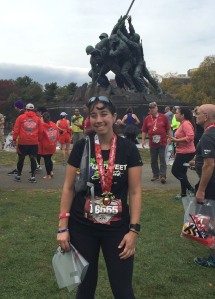
The race I’m probably most proud of (despite my time) was my first marathon last month. I did the Marine Corps Marathon in Washington D.C. and it is an experience I will never forget. My hip flexors are still reminding me how unforgettable it was.

Before I left for DC, my high school coach Harry Skandera (who I coach with now at RVC) thought it might be really encouraging to me to share a story about how he hated running one of his first marathons so much that he crawled under a car in the middle of the race and just laid there for a while. He still got up, finished in a decent time and even ran a few more marathons later on I believe. It was pretty funny to think about my All-American coach, who took our high school to state multiple times, collapsed under a car in the middle of a race. It also wasn’t particularly uplifting, so one of my race goals became “don’t crawl under a car.”

It is definitely the most mentally and physically challenging run I have ever completed, and there were multiple times throughout the race I would happily have given up the finisher’s medal just to crawl under a car for a few minutes. I missed my time goal pretty severely, but I didn’t crawl under a car and I finished so that’s a plus.


You have a fascinating blog called “thisloveitlookslikesomething”. I’m wondering if you have a Christian perspective of running, since running mirrors life in so many ways – hard work, patience, practice, sometimes real pain and suffering, and even jubilation.

Dec15Melody_Murdoch05I’m impressed you found my blog! I thought only my mom and best friend read it. My faith has always been an integral part of my running and vice versa. The first time I ever heard about the sport of cross-country was when Sara Bei Hall spoke at my basketball awards in junior high I think right after she won Footlocker nationals. During her speech, she spoke a lot about her faith being part of her running.

I went out for cross-country a few years later and started to understand what she was talking about. I used to carry this wrinkled old piece of paper with a couple of quotes on it around in my spike bag to read before races. On it was a Bible verse (Is. 40:31) and a portion of Eric Liddell’s speech from Chariots of Fire. It’s a much longer quote than this, but it ends with: “If you commit yourself to the love of Christ, then that is how you run a straight race.”

My blog posts are responses to the question of “What does love look like?” My life motto used to be pretty long and dramatic, but over the last five years or so I’ve whittled it down to this: love well and love more.

What do you think of this video? Have you seen it before? https://www.youtube.com/watch?v=lJH6eG1dYik

Dec15Melody_Murdoch09AI had never seen it before, but I really liked it! I think the idea of doing something hard is starting to become foreign in today’s Western society. We’ve also started to develop a somewhat coddling culture where “every kid makes the team” and “everyone’s a winner.” I wrote an op-ed piece when I was the opinion editor at the PLNU student newspaper in response to a Boston Globe article about how teachers were switching to purple pens because red ink was “shown to have negative psychological effects.” I think this line of reasoning just sets you up to struggle so much more because it’s not real life. We will all face hardship and we will all have a dream we will have to work to achieve. Running is a sport where it’s pretty easy to see who worked out and who didn’t. The work isn’t easy.

Comparatively, the faith walk is not an easy task. It takes hard work. It’s easy to talk a big game and say you’re a certain kind of Christian. It’s not easy when hard things come, big questions pop up and you’re made fun of for your beliefs. It’s also easy to talk up a race and say you’re a certain kind of runner. It’s not easy when injuries come, goals aren’t met and people doubt your potential. You always have a decision – quit or keep on running?

What are your running goals for the future? Have you signed up for any races in 2016?

I think I’d like to change it up a little bit and do a lot more of my least favorite hard thing – speed work. I love the Summer Track series and got to coach an introductory youth track club for 6 – 12-year-olds through Fleet Feet last year where we trained to run the series so that was a blast. I started trying to chase down some of my college track times because I think I’m stronger now than I was then. Still have some work to do there, but getting to run with my high school athletes a few days a week is an easy way to push myself.

My first half was the Annadel Half so I’ve done that the last couple of years, and I’ll probably do it again this year. During the race this year I was on track to PR by around 10 minutes, fell down pretty hard around mile eight, and then got so upset about it that I PR’d by over 18 minutes! I’m sorry to say the Fall=PR Strategy worked multiple times in 2015, so I’m adamantly looking to improve my race strategy for 2016. You know, just to avoid further scars.

Dec15Melody_Murdoch09B


Destination Central Vietnam, by Doug Murdoch

11226081_1060325203991763_8806700421101960724_o copy copyGoing to a foreign country for a destination race can be fun, but you need to make sure there are plenty of things to do besides just running at your location if you want to have a good time.

DaNang is located right in the center of Vietnam, with the ancient citadel of Hue and Bach Na National park to the north,  and the Japanese / French city of Hoi An to the south, along with My Son, which is a sacred place from the Cham culture dating 400-1400 AD.

Laguna Lang, which is a resort area north of Da Nang, offered a marathon / half this year, so I decided to run the half marathon and then explore the surrounding area. I spent about a week and a half in the area, but I could have easily spent two weeks since there was so much to do.

CentralVietnamDHM2015_003 copyIt was a small race with about two hundred people total – 80 in the marathon and 120 in the half marathon.  It was well organized and enjoyable, with almost all of it on even paved roads with no traffic and plenty of aid stations. It was out in the countryside but all the streets were still blocked off to traffic.

CentralVietnamDHM2015_004 copyAfter the race, I travelled about an hour north to Hue, the ancient city and capital of Vietnam.  The ancient citadel still has a wall and a moat that goes all the way around it. I ran the internal perimeter for fun and it’s about 5 miles. I also took a boating trip, went to ancient tombs, and ate some river snake (which did not taste like chicken). https://en.wikipedia.org/wiki/Huế
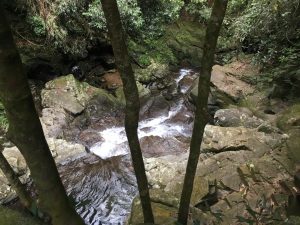
Here’s an example of a typical training run I did there: https://connect.garmin.com/activity/939307839

CentralVietnamDHM2015_005 copyAfter exploring Hue, I hired a driver to take me to the top of Bach Ma National Park, which is about five thousand feet, and spent the day hiking.  It’s interesting to be near the beach and then immediately go up to five thousand feet, in a completely different environment.  https://en.wikipedia.org/wiki/Bạch_Mã_National_Park

That same day my driver dropped me off in Hoi An, a beautiful little city south of Da Nang with both Japanese and French influences. One of the most famous attractions there is a traditional and authentic Japanese covered bridge.  The cost for an all day driver/ tourist guide in a private car was eighty dollars, and one way was about one hundred miles. I could have done it for less than ten dollars on a bus but then I would not have been able to go hiking. https://en.wikipedia.org/wiki/Hội_An

CentralVietnamDHM2015_006 copyEven though I did the typical tourist stuff,  I ran every day from 6 -10 miles which is always an eye opening experience. The main photo for this article, seen to the right,  is from one of the small islands that I ran to and around in Hoi An. This is my actual run in Hoi An where I took the photo: https://connect.garmin.com/activity/941822555

CentralVietnamDHM2015_010 copy 2I also went to My Son, which about two hours by bus to the south. My Son is a collection of Hindu temples that were built between 400 – 1400 AD. https://en.wikipedia.org/wiki/Mỹ_Sơn

This is a good reference for what you can do in the area: http://www.danangexperience.com/wheretogo.html

If you want to stay at a beach resort before and after your race, the race that I ran in is quite good but in a remote beach area: http://lagunalangcomarathon.com/home/

CentralVietnamDHM2015_013 copyAnother popular one, which I might do next time, is called the Da Nang Marathon (and half, 10K, etc).  It is in Da Nang, which is still on the beach, but the hotel prices are much cheaper and there is more to do.  It is a much larger and international event. http://www.rundanang.com

Although it’s not in Central Vietnam, perhaps the most adventurous race in Vietnam is the Sapa Mountain running series, in north Vietnam. It’s on my bucket list. http://vietnammountainmarathon.com

I’ve spent a lot of time in Vietnam so if you have any questions about traveling and running in Vietnam, feel free to leave a comment!


Shawn Sullivan: Pine to Palm 100 – 23:03:42

Nov15_Sullivan002Question: Hi Shawn, congratulations on finishing the Pine to Palm 100 miler in less than 24 hours and getting 9th place! That is a huge accomplishment! What motivated you to enter this particular race? Is it the longest race you have completed so far?

Answer: This is the longest distance I’ve raced but this would be my third hundred miler…I was actually at this race last year crewing and pacing another runner. I knew before my runner was even halfway through the race that this was a race I wanted to do – it’s beautiful course, great vibe, and great people .

Nov15Murdoch05

Running 100 miles means you have a lot of time to think about things on the trail. Do you have a strategy for keeping your mind focused?Does your mind sometimes attempt to convince yourself that you should stop and give up? How do you deal with the psychological aspects of running so far?

Well although you’re thinking about the finish line, you should really run aid station to aid station, and breaking it in smaller chunks helps a lot. Your mind tells you not to even show up at the start line…haha, but yes it can be a battle in your head at any moment or the entire time! I have started using an iPod on these long ones – I’ll usually have an audiobook and a bunch of different music .

Nov15Murdoch07How did you survive the “three epic climbs of 7000 feet” with over 20K of elevation gain? Did you ever have to walk?

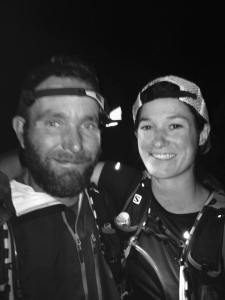
Oh yeah, you walk or power hike, although I don’t think I walked a step up until 35-40 miles in. If you’re running slow enough that you could be walking the same speed then you should be walking and keeping your heart rate down. The first climb was really good and I was fresh, my adrenaline was going (on 2 1/2 hours sleep even),  plus running at the front you kind of feel like you’re being chased. The second climb was pretty awesome as well – I was really excited to get to the top of Dutchmen Peak because I had just climbed back into third place (after losing about six spots) and I would be getting a pacer when I got to the top. The third climb was not so great.  I had quit eating about 10 miles before this climb, apparently my stomach was not OK with me eating around 25 Roctanes and a few other gels. Although the view at the top of Wagner Butte is pretty awesome it looks down on Medford I believe, and this was the toughest part of the race for me.

Nov15_Sullivan009

Do you “enjoy” these long races? How would you describe the experience and the outcome? Is it the challenge that it is seemingly impossible? Is it the special belt buckle you get at the end?

Oh definitely I love these things, there’s such a sense of community and family in trail running. The experience itself is kind of hard to put into words, how you feel from moment to moment during the race isn’t necessarily the same as when you reflect on the overall endeavor. You may have extreme lows that seem unsurpassable in the moment but slightly less significant when you look back at the big picture. And yeah the belt buckle is pretty sweet too.

Nov15_Sullivan010

What does your body experience after twenty miles……forty miles……sixty miles…..eighty miles………?? Do you find that your body goes through various stages ranging from feeling ok to feeling like your entire body is rebelling against you?

Oh man that’s so hard to answer! It’s always different, I don’t blister so that’s never an issue.  Depending on how long I’m out there the sleep monster tries to get me at some point or maybe multiple points.

And yes my body has rebelled in so many ways, and although seemingly impossible at the moment most things can be overcome, barring causing permanent damage of course.

Nov15_Sullivan007

What is your hydration and nutrition strategy? How often do you drink and eat, and what? Do you ever get sick, meaning either diarrhea or throwing up? Anything special in your drop bags at the aid stations?

Nutrition is a constant learning process for me. Up to the 50 K distance I used to just drink Cokes and eat Oreos. These days I’m trying to use just mixes and gels, they’re so convenient in so many ways. For me I try to be consistently eating and drinking, a slow steady flow into my stomach works best. I’ve gotten sick a few times, nothing too bad, but it’s just convincing yourself to eat afterwards that’s the hard part. Drop bags hmm – depending on the course layout and crew availability maybe a light rain jacket and headlamp. Individual wet wipes can be very handy…….you get pretty dirty out there.

Nov15_Sullivan004

During the race itself, do you have any stories of anything that happened? Something interesting that happened along the way?

Ha!  Yeah we were just talking about this – one of my pacers/crew who shall remain nameless (Jeff Knapp) apparently took a projectile bottlecap to the face. Apparently when you take a homebrew up a few thousand feet it might not respond well? Hopefully I can get you a picture one of the course photographers snapped.

During a standard 10K, basically everyone is out there running for themselves and it’s over pretty fast. In a long race like this, do the competitors help each other?

Nov15_Sullivan003

Yeah the community feeling in these races is awesome, you’re all out there to get it done and cross that finish line, just some faster than others. And yes, as a matter fact, I was getting dehydrated about 35 miles in due to overshooting my crew by 45 minutes and not being able to get an extra bottle for the exposed section coming up. I figured when I got to the aid station I would just drink extra and take some salt with me but that aid station hadn’t gotten any salt tabs yet so a few miles out from that aid station a fellow competitor passed me and asked “Do you need anything?” and gladly offered up some salt tabs. This is one of the many reasons I love ultra running. I don’t think any of us would leave a fellow runner in distress if we could help,  just for the sake of beating them.

Based on the results, I counted that 120 people started the race, but only 75 finished – that’s a 37% drop out rate. Almost all of them quit at 52 miles or less. Why do you think so many people drop out?

Nov15_Sullivan001

Hundred mile races are tough and this course is no joke. To start the first 10 miles is just a consistent climb followed by a 10 mile dissent and then mile 30 to 50 was pretty exposed.  That could have something to do with why most runners dropped at 52 miles.

What was your greatest high during the race? And compare that to your worst low?

Greatest high would be running up to the top of Dutchmen peak after taking several spots back and now being back on the podium …biggest low was probably climbing Wagner Butte – it’s not even that long of a climb but it just never seemed to end.

Did you do anything to reward yourself after the race?

I took a nap ….

Nov15_Sullivan005

Would you recommend this run to someone considering their first 100 Miler?

Sure – it’s a very doable course in a beautiful area, and you can’t beat a point to point race.

__________________________________________________________________________

Here is the link to the Pine to Palm 100 website: http://www.roguevalleyrunners.com/P2P100/raceinfo.html  

Here is the link to the results: http://www.ultralive.net/p2p/webcast.php

2015 Ilsanjo Classic 10 Miler, Neo-Classic 4-Miler, and Newt Scoot, March 8th, 2015

Running in Prescott, Arizona, by Doug Murdoch

I recently spent a week in Prescott, Arizona and all I can say is that the running trails there are outstanding,  with most trails at  4500 – 6500 hundred feet elevation.

Nov15Murdoch04

The run that I photographed is at the base of Granite Mountain, which had everything from flat wide trails to small rolling hills, through forested and large bouldered areas, as well as some scenic views. Here is the Garmin link to look at the run on a map: https://connect.garmin.com/activity/917153383

Nov15Murdoch05

Most runners focus their attention on Flagstaff to the north of Prescott, and Flagstaff does have some incredible running. But the thing about Prescott is the wide variety of running trails all within twenty minutes of downtown.  The town has really done a great job of creating, maintaining, and marking the trails.

Nov15Murdoch06

In my opinion it’s a great running destination vacation spot. Plus your  close to Sedona, and it’s not so far to Flagstaff (about an hour and half north).


Here are some other runs that I did while in Prescott:

Pevine Trail: Flat, wide dirt trail that used to be a railroad line.  About 6 miles roundtrip to the Y junction, but it could be extended with the trail below for 14 miles total.  Garmin link: https://connect.garmin.com/activity/912589787

Iron Springs Trail: This one starts in Prescott Valley and goes west to meet up with the Pevine Trail above.  Another flat rockless trail.  8 miles roundtrip, but you could make it more  or less as desired. Garmin link: https://connect.garmin.com/activity/914434792

Pioneer Park: Lots of trails to choose from  – rolling small hills to medium rocky trails. Garmin link: https://connect.garmin.com/activity/913515567

Goldwater Lakes:  Beautiful trail-run passing two lakes – if you go the full distance, it’s about 9 miles round trip. Highly recommended. Garmin link: https://connect.garmin.com/activity/94527507

Granite Mountain Area:  A fantastic location – many possibilities. About twenty minutes from downtown.  This is where the photos were taken for this blog post.  Garmin link: https://connect.garmin.com/activity/917153383

Nov15Murdoch02

Running’s my Time Machine: Thankful at 50, by Doug Murdoch

When I was a kid I loved movies that showed time machines like Time Bandits and Back to The Future, because I wanted to travel in time. And yes, I also loved the first Hot Tub Time Machine movie, because it took me back to when I was a young adult in the 80’s.

I never imagined that running would end up being my time machine. It’s taken me to a place where I’ve been able to run with teenagers and college students, and not get last place. One of my most memorable races this year was at the Empire Summer Series Track Meet #1, running the mile, with the youngsters. Even though most of them were running the race as a workout, it didn’t matter. I was running free and keeping up with high school students and some college students, feeling light on my feet and crossing the finish line with them.  For a few minutes I was able to glide and float on the track and not feel the aches and pains and chronic Achilles tendon soreness that I normally feel. I was young.

Oct15Murdoch2
Empire Runners Club 2015 Summer Track Series Meet #1, Mile Run results for males (partial list).

Of course, the important variable here is that I turned 50 last February.

Turning 50 has been challenging. At first, it was about body perception and aging issues for me.

At the beginning of the year, I grew a full beard, not only because I hate to shave, but because it had become acceptable in popular culture and I figured this was my chance. My nineteen-year-old son Dylan had some of his friends over to the house, and I asked them if I looked like a Hipster. They paused for a moment and then told me seriously that I just looked old. I looked in the mirror and saw a skinny white guy with a mangy salt and pepper beard on my face. I shaved it off after the Valley Ford Relays, no longer wanting to look and feel like a man lost at sea.

Oct15Murdoch4
My last photo before I shaved my beard off.

I also had friends and business associates commenting on how skinny I was.

I tried to explain to them that I was running sixty miles a week, including intervals, but it didn’t seem to register with them what happens to someone’s body when you attempt to run at a high level. I went from ”skinny” to “very skinny.” Many of these people knew me as “Fat Doug,” my nickname for myself when I was hovering at two hundred pounds. At that time, the only people that commented about my weight were my father and my wife. But when I got skinny, I received a comment about every two weeks – people wondering if I was healthy or not, or making comments like I should put some “meat on my bones.” One person even asked me if I had cancer. This bothered me. When I was “fat,” no one made comments because I suppose it’s not politically correct, but since I’ve been skinny people make comments all the time. Even though I weigh the same as when I was running in college, at times it has made me question if something is really wrong with me.

The Half Century Ass Kickers relay team at the Valley Ford Relays, left to right: Suzanna Bon, Guy Schott, Cathy DuBay, and Doug Murdoch. We broke the mixed 50 and over record by six minutes, which also put us at #6 on the all time mixed list.

Turning 50 has also been about witnessing the changes in my eighty-year-old parents, and realizing that I will be there soon.

I’ve lived long enough now that I feel like I know what it’s like to live a decade and can multiply that in my mind two or three times, and be where my parents are now. When I turned 40, I wasn’t able to project forward decades into the future and imagine being there, and I didn’t have the empathy for what happens to all of us when we get older. I have watched my parents suffer and optimistically endure through stomach cancer, diabetes, macular degeneration, arthritis, cataract surgery – the list is endless. And to their credit or dismay, they don’t tell my sister or I about their problems until after they get out of the hospital – because they don’t want us to worry.

So I am thoughtfully thankful to be running so well and in shape at fifty years old, and I don’t take that for granted.

Oct15Murdoch7
1500M prelims heat #2 men’s 50-54, world masters track championships, Lyon, France, 2015. Doug was first in 4:26.35.

Some of my high school friends are having a tough time as well.

My high school and college track and cross country friend, Kevin, is dealing with the fact that his father, Elmer, is suffering from a number of issues – hydrocephalus (fluid in the brain), blood clots in the brain, has suffered a couple of strokes, and has had trouble talking. Kevin doesn’t know if he will live through the end of the year. As my friends start to deal with dying parents, I start to suffer as well, knowing that in short time I will be experiencing something similar with my parents.

Another high school friend of mine, Eric, who ran some excellent 10K times while at Sonoma State, broke his back in three places, and combined with knee injuries, can no longer run. We were talking this summer and he told me that I was running “for the rest of us” (who can’t run anymore). That struck a chord.

And the week before I left for France this year for the world masters track championships, I received a group email from one of my high school friends that had been on the track team with me, informing us he had Multiple System Atrophy, and that most likely he would die in the next few years. When I read his email I was stunned – he is 50 as well. And so I ask myself, why am I running so well and yet my high school track compatriot is suffering in a wheelchair?

The obvious answer is a combination of genetics, determination, and luck. But I’m more interested in the abstract questions that lie beyond a purely rational explanation. Why do some people suffer more than others? How do we find meaning in the midst of the inevitability of physical and mental suffering?

Oct15Murdoch8
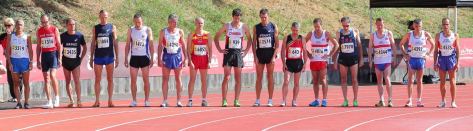
Men’s age 50-54 1500M finals at the world masters track championships, Lyon, France, 2015. Doug is fourth from the right.

When I was young attending Cal State University Northridge, I naively thought that if I went to the Oviatt Library enough then I would find the answers somewhere deep within the rows and shelves of books. Towards the end of college I realized that I was not going to find the answers there, and believed that my life experiences might behold some truths. But now at fifty, with five decades of experience, the answers have not revealed themselves. I know that I’m responsible for applying my own meaning, but I keep procrastinating.

From a training point of view, there are a couple of key points. I’ve been able to manage my injuries and get them treated so that I can continuously keep running month after month. Prior to this year I’ve had to take days, weeks, and sometimes months off due to injuries. The second factor has been allowing my body to fully recover after a hard workout or a race by doing easy runs until I felt ready for another hard workout, which for me has been three to five full days. Although this has put me on an irregular 8–10 day workout schedule, it has worked for me. I can come up with a full list, like how I increased my mileage to sixty miles per week, the type of intervals I did, etc., but for me it is still not a satisfactory answer as to why I’m running so well as compared to others. Is it because I took 27 years off of running before I started again? My friend John has a theory that masters’ runners that did not run for years and years do better when they’re older because they have not stressed their tendons, ligaments, and muscles for so many years.

Oct15Murdoch9
One lap to go, men’s age 50-54 1500M finals at the world masters track championships, Lyon, France, 2015. Doug was 13th in 4:24.72. His PR for the year was 4:23.12 at the USATF National Masters Championships, getting 2nd place.

So at 50 the reality of aging and suffering has been an emotional blender of self-reflection. My bachelor’s degree in philosophy does not seem to be helping.

But running has allowed me to forget about those things if only for a few minutes at a time. Running a track race is so intense for me that my mind is purged of extraneous thoughts and all I can do is focus on the race itself. Maybe that’s why I love track – the adrenaline rush before the race, the dread of having to push my body to the limits, the single mindedness of the event, and being completely submerged for a few minutes in time. In those moments I feel completely alive and in motion. Once I cross the finish line, reality swiftly returns. I often think as humans we’re simply keeping busy all the time to keep our minds off of our own mortality and the painful things that are right in front of us. Running keeps me busy.

Ultimately I am so thankful simply to be fully healthy and running so well at fifty years old. When I started running five years ago I never imagined that I would run this fast. I’m so thankful at 50, for everything.

And running a master’s personal record means so much more, because you realize that it may be the apex of your career as an older runner. As hard as I may try the following year, I may not run as fast. I may enter the phase of declining times for the rest of my life.

As for running as a time machine, I’m hoping that it will still work for the years to come, because feeling young again is incredible. No matter what my times are, if running can make me feel significantly younger, than I plan to keep running indefinitely, on the longest of runs.